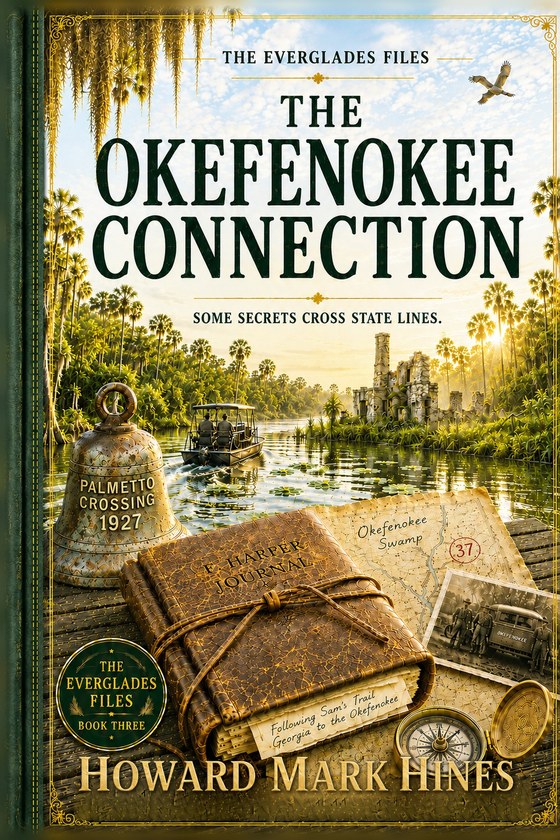
The Okefenokee Connection
A single line in her father's handwriting sends Sheriff Maxine “Max” Harper hundreds of miles from her own territory. Ask Calder. Following an old, circled notation on one of Frank Harper's maps, Max and her closest friends Chet, Zeb, and Hank cross into the black water and cypress of Georgia's Okefenokee Swamp, chasing a place that no longer appears on any map at all, a forgotten settlement called Palmetto Crossing.
An elderly local named Vernon Calder still keeps the settlement's old schoolhouse bell, its brass scratched with a number that once stood for thirty-seven families. In May of 1952, the fish began dying in the water, then the children, and within weeks the government renamed the vanished community District Thirty-Seven and buried its history along with it. Frank Harper spent years quietly trying to find out why.
The trail leads Max south again, to the crumbling remains of a federal research annex far too large, too well wired, and too well equipped for the simple records office it claimed to be. Whatever happened at Palmetto Crossing did not end there, and whatever her father uncovered about it cost him more than she ever knew, right down to a family name he chose, deliberately, to leave alone.
As Max follows her father's restraint as closely as his research, she begins to understand that some truths are not hidden only to protect the guilty. Sometimes they are hidden to protect the people who survived them, and knowing the difference may be the hardest lesson Frank Harper ever left behind for his daughter to learn.
The Okefenokee Connection is the third novel in Howard Mark Hines' Everglades Files series, a Florida and Georgia mystery about a forgotten settlement, a father's careful silences, and a daughter learning that some searches are only finished once you know when to stop.